
13 Questions to Ask a Podcast Production Company Before You Hire Them
If you’re deciding whether or not to hire a production company for your comapny’s podcast, you want to make sure you get all of the information you need to make the right decision.
Do you Need a Production Company for Your Podcast?
Yes, you probably do. Unless, of course, you’re burdened with an abundance of free time and a desire to learn a set of new, highly technical skills and strategies.
This is especially true if you’re a lawyer, consultant or expert business owner who would rather be billing hours and doing client work than fiddling with audio software.
But there are a lot of options out there – freelancers, agencies, podcast coaches, niche studios, training providers – all with wildly different pricing, styles, and service levels.
And as you probably know, hiring a third-party provider can be an… ordeal. When hiring for a podcast, it’s also fairly high-risk. Your show needs to reflect well on your company and help you achieve important goals so the provider you choose to work with needs to be reliable and produce high-quality work that, in some way, increases your profitability.
When you work with a great one, then creating your podcast is going to be a really pleasant part of your workflow; you’ll get to focus on creating interesting and valuable content and won’t have to do much else while the benefits to your business stack up. But if you end up with a less than satisfactory one, it can vary from a lackluster experience with middling results all the way to an expensive, time-sucking nightmare.
I’m Megan Dougherty, the co-founder of One Stone Creative, and I’ve had far more conversations with people who hated their production partner than I’d care to remember. At One Stone Creative, we’ve been producing podcasts for expert business owners for 9 years and have worked with dozens of different firms, sometimes creating new shows from scratch, and sometimes taking over shows started with enthusiasm, but that weren’t creating the results required.
Based on this experience, these questions are what my team and I think you should ask any podcast production agency or vendor before you sign a deal with them, and what their answers will tell you. There aren’t right or wrong answers – just right or wrong for your specific business and show.
You should make sure to speak with at least 2 or 3 different vendors before making your choice, to get a sense of your options. We’d love to be one of them. Book a call using the link below.
13 Questions to Ask When Looking for a Podcast Production Company
1. What does a successful podcast look like for your company?
As a producer, this is one of my favorite questions to be asked, because it means that someone is thinking seriously about how to evaluate the podcast as a marketing channel. Success can mean all sorts of things, from particular download numbers to on-time releases, and the length of time a podcast lasts, to much more nebulous things like getting invited to speak at more conferences or shortening your sales cycle.
What they say isn’t as important as the fact that they have an answer to this question. The answer can be “it depends,” but they need to be able to tell you what it depends on and how the determination of what successful means for YOUR podcast is going to be made. What you don’t want to hear is something like “downloads” or “there’s no way to evaluate success” or “whatever you want!” That’s not really helpful for a business show.
If their vision of success matches your vision of success, they pass!
One Stone Creative Answer: A successful podcast is one that is regularly making measurable progress towards one or more business goals like more referrals, shorter sales cycles, warmer leads, better search visibility and more opportunities to speak or present. Identifying those goals and designing a show optimized to achieve them is how we begin all production relationships, and we track results monthly. Success depends on how well we achieve the goals that are important for your business.
2. What kind of contract or service agreement will we be entering into?
Any provider is going to have a contract or services agreement that you need to sign in order to do business together. That’s just practical, and a lot of what goes into those contracts is boilerplate: you own your content, we do A, B and C tasks for each episode, here is how we handle liability and emergencies, when does audio need to be submitted, what are the feedback processes etc.
One of the things you should take a close look at is the length of the term of service.
There are providers who work month to month and allow a variable number of episodes, those who work on a per-episode basis, those with specific packages for a certain amount of episodes and deliverables, and those who require commitments of up to a year. There are still others that let you cancel at any time or with a certain amount of notice. Make sure you end up working with a company that offers you the level of flexibility or stability that works best for your firm.
One Stone Creative Answer: Our Services Agreement covers who owns what copyrights to work (all IP belongs to our clients!), details funding and payment terms, and has clauses for what happens in case of major emergencies like fire, flood, and zombies. It also goes into where content information will be stored, who will have access to it, and how that information will be handled at the end of the service. We also detail client and producer responsibilities, like turnaround time and deadlines, and list exactly what deliverables go along with each episode.
The agreement is in place for 30 days, and renews monthly unless cancelled, which can be done at any time with 30-days notice, so we can accurately plan each month’s production work. Our reasoning is that if it’s not a fit, it’s not a fit and everyone will be happier moving on in that case!
3. Who’s in charge of managing the episode process?
There are a lot of moving parts in every podcast episode: finding and inviting guests, preparing for the call, recording, audio editing, asset creation, scheduling and promotion, so it is extremely important to get clear on who owns (is in charge of) the high-level process. Who is going to make sure everything is done at the right time, and in the right way? This is basically like asking whose desk is the project management for the podcast on.
Different companies are going to take responsibility for different elements, and some are more proactive about things like making sure you get your audio recorded on time, getting reviews and feedback organized and scheduling episodes than others, so you want to make sure you’ve got clarity on exactly what you can expect in terms of who is going to be “owning” the podcast.
One Stone Creative Answer: We do! Outside of recording the content and arranging guest interviews (which we can help with), we project manage the entire podcast, from receiving raw audio to the content being scheduled on all platforms, including notifying the guest, if there is one, that their episode is live.
4. Where are the handoff points and how do we share content and feedback?
There are going to be points where you need to get content and audio to your producer, and they need to get information and content back to you.
What are the points in the workflow for each episode where that happens, and what is the method it happens by? Do they have a dashboard or portal they need you to use to send them raw audio? Do they upload finished content to your Dropbox? Is email the best and fastest way to submit your feedback on an episode, or is there a shared project management system where you can tag someone into a conversation?
There are no right or wrong answers here. But you need to make sure that you’re going to be able to integrate your workflows effectively, and sometimes, when you get into the nitty-gritty, you find a dealbreaker. It’s good to fully explore in advance.
One Stone Creative Answer: Our key handover points are when we receive raw audio from our clients. That audio can be uploaded to our shared Google Drive via direct upload with an accompanying email, or through a form we provide.
The next one is when we submit finished content back to the client for review. We upload content to the shared workspace and email that it is ready.
We send a final email when the episode has been fully scheduled, and populate a stats tracking document monthly, which is reviewed during monthly or quarterly strategy calls.
5. Is there any kind of coaching, feedback or strategic help provided?
If you want to improve your skills as a podcast host or need support around leveraging the show in different areas of your business, then you probably want a provider that offers coaching, feedback, and/or strategic consulting. This isn’t needed for every show, but if it’s something you’re interested in, you will definitely want to know in advance!
As about what type of feedback is provided. You might hear answers like: “we provide detailed feedback on sound capture and your recording setup.” Which is great if that is your need, but if what you’re looking for is interviewing and performance critiques, you’ll want to work with someone else.
Similarly, you may want to work with someone who can keep an eye on your stats and progress towards podcast-adjacent goals, you can learn through a discovery call if a provider is more focused on downloads and social shares, or more holistic metrics.
One Stone Creative Answer: We offer content feedback on request for whatever the current area of focus for improvement within a show is like welcomes, closings or transitions, interviewing style and general performance, as well as sound and recording. We also track any and all monthly stats and have monthly or quarterly strategy calls to evaluate progress and make plans.
6. What’s the turnaround time from raw audio to finished episode?
This can vary wildly from company to company. Some editors and agencies can turn an episode around in a few days or even hours. Others take longer, up to a week or more. There isn’t a right or wrong amount of time, but you can usually expect that the more assets provided, like show notes and sharing materials, and the more complex the editing, the longer it will take. The most important consideration here isn’t finding the fastest turnaround; it’s establishing that you can make YOUR workflow match THEIR workflow.
If the answer to “What is your turnaround time?” isn’t clear or can’t be easily explained to you, I would consider that a red flag. When thinking about the turnaround time, one thing to consider is how topical your content is. If you want a daily news commentary show, you’ll need a hyper-fast turnaround time. If you’re doing interviews that are generally evergreen or can be produced well in advance of release, then it’s not as critical.
One Stone Creative Answer: We work on a 7-day production schedule for podcasts that require notes, sharing assets, and scheduling. If it is an audio-only project, it can be closer to 3 days. Some shows are done on a batch basis, where all content is recorded at once, then produced, then published all at once.
7. Are they using AI? And if so – how?
Whatever kind of producer or production company you end up working with, they will probably be integrating AI one way or another. There are dozens (at least!) of AI-powered services to write show notes, clip videos, enhance audio and even develop scripts and episode titles. This isn’t necessarily a bad thing, but it’s a very good idea to understand exactly what the company you work with is using AI for and what kind of quality assurance mechanisms they have in place so that you don’t wind up with misspelled guest names, choppy, degraded audio, or generic social media posts.
Ask what tools they’re using at what point in the process, and exactly how humans are reviewing the work the AI tools produce before the content comes back to you or goes live to the rest of the world. Do not hire anyone who cannot tell you that a human will be personally reviewing and responsible for any AI assisted content.
One Stone Creative Answer: We have experimented with a lot of different AI programs, and test new ones as they come out. We have at various times used a writing-assistance tool to develop the first draft of show notes and social media shares, which were then reviewed and edited for accuracy and tone. Ultimately, we abandoned those services because, considering that each episode also gets a quality assurance listen by a human, it costs less and is more accurate to have that person do it right the first time. Likewise with clip selection, we have found that our audio and video editors do a better job selecting clips while they are editing than hoping an AI tool surfaces something good. (Purposefully recorded short form videos are much more effective strategically, however!)
Where we have found a legitimate use for AI assitance tools is when there is a wide variance in quality between the host and guest’s audio. In that case we use an audio-improvement AI feaure of our editing software to slightly balance out the sound.
8. What assets do they provide?
Common assets that go along with podcasts are show notes and descriptions, different kinds of social media shares, including text and graphics, audiograms and short form videos like reels or shorts, emails, video versions of the show, sharing materials for your guests and even things like opt-in content and blog posts. Admin tasks like guest research, scheduling episodes on podcast hosts and blogs, and scheduling social media posts and announcement emails can also be included.
Depending on how much support you need with the show and how much bandwidth and skill there is on your own team, you might need more or less from a production company in terms of deliverables that go with each episode. If you have an amazing social media team and the best admin ever, you don’t need those services from a provider and can focus on getting a service or package that includes just what you don’t have available in-house.
Something I would like to mention here is that you are much less likely to find a single individual who is going to be able to do really high quality, complex podcast editing AND cool graphic design and fluent social media post writing. It is a lot of different skill sets, and while I am sure such humans do exist, they are rare and expensive (as they should be!), which often makes agencies the best choice for a podcast with high content and support needs. They have different people and departments that are experts in each production area. If, on the other hand, you’ve got great writers and designers and admin support in-house, let them do what they’re great at and find an individual provider who can give you awesome audio without worrying about the rest.
One Stone Creative Answer: We’re pretty flexible in this regard. We can include everything mentioned above, including scheduling of all assets, but let our clients customize their production package to include exactly what they need and none of what they don’t.
9. Who is providing the service and who are the points of contact?
Podcast production companies and agencies come in all shapes and sizes and organize the work in different ways. As a potential client, it’s important to know who your points of contact are and what, if any, contact you will have with other members of the team.
Will you have a dedicated account manager who is familiar with your show? When you have a question, who do you ask, and what is the best way to get in touch with them? Will you have a dedicated producer who will get to know you and your show and your editing preferences, or are there standards and edits that get applied to all shows? If getting feedback is part of the service, who provides it, and is it a two-way dialogue? Basically, you want to be very clear about who is handling your content and how you make sure you all have the information that you need as the production relationship evolves.
One Stone Creative Answer: We assign dedicated people to each podcast we produce so that the same person is always handling the audio/video editing, feedback, strategy, notes and admin. This lets us become familiar with the style and direction of each podcast. We do believe in vacations, however, so we develop detailed standard operating procedures for each show so we can help each other when needed. The account manager in charge of each show is the primary point of contact and liaises between different members of our team, and whatever members of the client’s team are involved.
10. If you are starting a new show, what is included in a launch? Follow up: how long will the podcast launch take?
Podcast launches provided by a podcast production company can be as simple as creating the first episode and pointing you at Apple Podcasts Connect or as complex as orchestrating a multi-channel, multi-media content extravaganza complete with a launch team and listener contest.
The provider you’re talking to should be able to tell you the linear steps in their launch process: what has to be done, in what order, and how long it usually takes. You’ll want to know what kind of show development support they provide. Will they be really hands-on in helping you design the different elements of your show, like the branding and the episode format, or will they just take what you send and produce it?
It’s the same thing for the rest of the elements of launch. Ask if they have different packages, what is the most popular, and how much time it’s all going to take. It’s also a good idea to ask about how custom the launch is going to be to YOU. If they have a standard launch they provide for all shows, that can be a good thing; it will likely be a smooth process that runs efficiently. But sometimes, you want something more personalized that takes advantage of your existing audience and community or the channels you’re currently using. Ask about how much collaboration and differentiation for your launch is going to be possible.
It’s typical for there to be a launch/setup fee for new podcasts and for podcast takeovers, so ask about those as well.
One Stone Creative Answer: We have a standard launch package for a new podcast (both audio and video versions) that includes show development, audio-visual branding, template and tracking infrastructure creation, a trailer episode, the first full episode, and support around tech submission. It includes everything needed to go from “I have an idea!” to “We’re on Spotify!” We can also add promotional assets like email and social media campaigns as needed.
For existing shows, we have a lower ‘takeover’ rate that simply covers getting the show integrated into our systems for a seamless transition.
11. What kind of editing do they offer?
There are many different kinds of podcast editing, and it’s reasonable to expect that different service providers will use different terms to describe them!
The person you are speaking with should be able to describe their editing style or styles clearly, explain what kind of sound improvement they do, like minimizing background noise, balancing the levels of the speakers, “sweetening” the overall sound, and explain any terms you’re not familiar with. They should also be able to tell you what kind of content editing they will do: removing filler words, cutting trailing questions out, and making editorial decisions about what should be included—the range can be big!
Sometimes, companies might be able to follow content edits you provide, like “remove the question and answer about balloons.” Other times they can make editorial decisions on their own.
Ideally, they can give you examples of shows they produce so you can listen to the finished product. (Do remember as you are reviewing shows that even the world’s best audio editor can’t work magic. If source audio is terrible, there is a hard limit to how much it can be improved. The host should always sound acceptable but be forgiving of weird or wonky guest audio. Sometimes, you just get what you get.)
The key thing to figure out with this question is what are you going to be responsible for providing in terms of editing decisions and what they are going to do. There might even be a process where you collaboratively establish content standards, and that’s awesome! Just know what you’re getting into so you don’t find yourself expecting something they can’t provide.
One Stone Creative Answer: For most shows, we do what we call ‘hygiene’ editing. This means improving the quality of the sound by lowering background noise (where possible!), balancing the volume between the speakers, and improving the overall tone and quality (sweetening!). We remove any obvious errors and re-starts and take editorial comments from clients when they have specific requests. The goal is to make the editing “invisible” and leave the host and guest, if there is one, sounding just a little smarter and more polished than they do in real life. For some shows, we can do more intensive editing and include content edits like re-arranging the parts of an episode and more music design. It depends on the needs of the show.
12. How long do their clients usually keep podcasting?
Many shows fizzle out after a few weeks or months in a sad process called podfading, where the project just loses steam and stops releasing. If you can avoid it, you should. It’s not like anyone will lose a leg if you don’t, but what a waste of time and resources – and not a great look if you announced it publicly.
Ideally, the provider you work with will have clients who have been podcasting for a long time. It’s a good indication that they’re providing quality service. This is FAR from a hard and fast rule, of course; brand new providers can provide fantastic service, and sometimes companies specialize in podcasts that have limited lifespans by design. This should just be one of the many elements you consider when choosing a provider.
Something else you should ask about is whether it’s possible to create a podcast season instead of a permanently ongoing show. For many businesses, this is an amazing fit, either to test the waters or to serve a specific business function and then move on.
One Stone Creative Answer: Our longest-running show has been going since 2018, and average tenure is over two years. We also LOVE podcast seasons – many businesses don’t need permanent ongoing shows. If a company just wants to nurture and pre-qualify new leads, 12 episodes is going to do it. We always recommend the style of show that is going to meet the business goals, whether that’s ongoing, micro, seasonal, or something entierly new.
13. What happens when something goes wrong?
This is kind of a tricky one because everyone sells based on things being great. But there will be problems. Humans make mistakes. You will, and your provider will. It happens.
So you want to know in advance what the provider’s approach to things like you submitting late audio, a recording too bad to release, or confusing instructions is going to be. Similarly, what if the producer makes an error in production, like missing a requested edit, adding the wrong intro, or misspelling a guest’s name?
It could be that they don’t have prepared answers to these kinds of questions, maybe you’re foreseeing problems they haven’t, or vice versa! But a willingness to collaborate with you to establish standards and best practices. For example, if raw audio is not submitted by X date, the editor will prepare a replay, or “any mistakes in editing will be fixed and re-uploaded free of charge,” which means you’re going to have consistency and, ultimately, trust. And that is the foundation of any good working relationship.
One Stone Creative Answer: While we try to avoid mistakes, as stated, it happens from time to time! We will always fix any error we make in the audio or assets as soon as we are made aware of it and at no additional charge. In the case of a client error, we are also happy to make after-release edits, although we prefer a pre-release review stage to avoid them! We guarantee on-time releases when we receive raw audio in time, and if we miss one for a reason within our control, we will discount the next month’s production by the amount of a full episode.

Final Thoughts on Hiring a Podcast Production Company
At the end of the day, the most important consideration in your choice of producer or editor is that you trust them with your content. You might only need someone to clean up your episodes and add the intro and outro. You might be looking for someone to take your hand and walk you through the process long term. It could be something in between. or, and I say this with all seriousness, it might come down to vibes.
The producer-host relationship can be an intimate one. You’re going to be trusting someone with your unedited audio and that can be a vulnerable thing. Liking the person or people you’re working with goes a long way to making the relationship a good one.
There isn’t a wrong thing to want from a third-party provider. The trick is to find someone who is happy and excited to provide what you’re looking for and who is clear about what they can, can’t, or won’t do.
If you’re currently evaluating podcast production companies, please check out our ongoing Business Podcast Production Services, Business Podcast Sprints (stand alone seasons) or Micro-Podcasts. We’d love to be one of the potential partners you speak with.
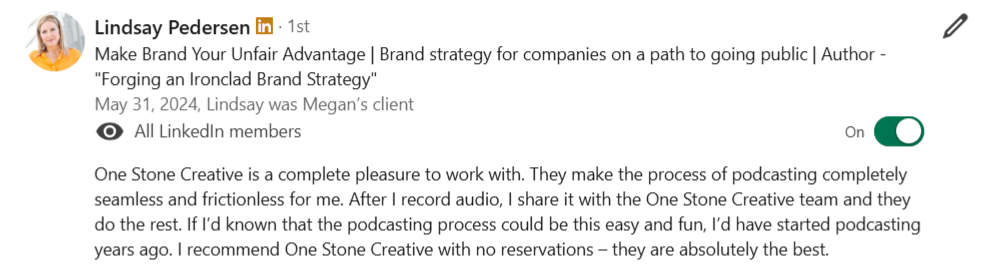
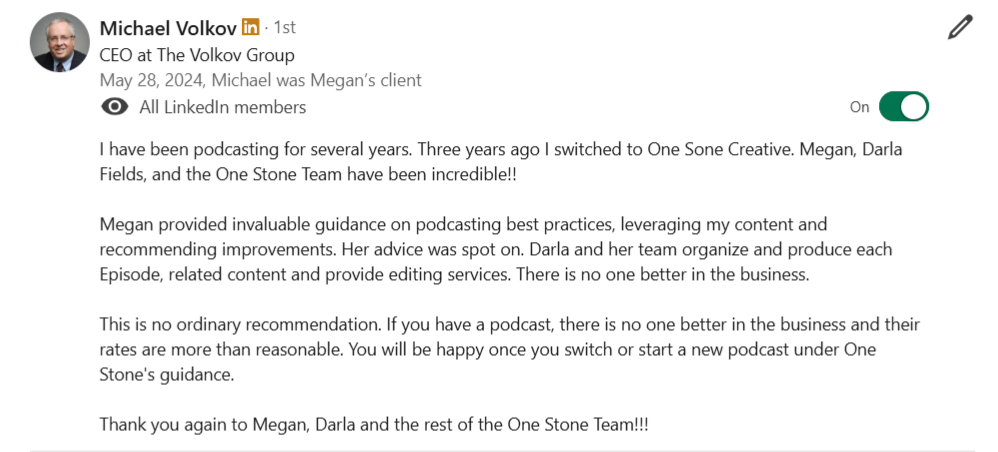
What People Have to Say about Working with One Stone Creative:
One Stone Creative produced the Unlearn Podcast from the spring of 2019, to 2024.
The team provided excellent strategy development, coaching and preparation during the planning and launch of the show, and consistently deliver crisp editing and detailed show notes. On an ongoing basis, they’ve offered interview coaching, brainstorming around strategies and ideas to improve the show. With their help my audience and podcasting skills continuously grow.
– Barry O’Reilly, The Unlearn Podcast
“The team of One Stone creative was a pure joy to work with on my podcast network.
They bring both professionalism and passion to being two of the top podcast producers and podcasting consultants around. If you are thinking about starting a podcast or have been podcasting for years as I have, they bring not only efficiency to your podcast production but real value for your entire operation. Two Thumbs up and Five Stars to the entire team of One Stone Creative.”
– Tox Fox, The Compliance Podcast Network
I’ll be honest. I started the Spin Sucks podcast with some trepidation. We talked about it for years, but I couldn’t just seem to get my butt in gear to get it done. I kept hearing things such as less than one percent of podcasts are hosted by women (according to Libsyn) and also watched the trajectory of podcasting and yet…
But then the amazingly brilliant and easy-to-work with women from One Stone Creative told me there is more than enough content on the blog to create a podcast. They said, in fact, I wouldn’t have to do any work, other than record something weekly. They made it so easy, it was impossible to say no. Thanks to them, we’re here 7 years later.
– Gini Dietrich, The Spin Sucks Podcast