2026
State of Business Podcasting Report
Learning from the Top 100 Business Podcasts.
Business Podcast
Show Notes and Websites
A question we receive all the time from business owners starting podcasts is: should it get its own website? In fact, this was one of the questions that inspired this entire report back in 2020 when we published the first one.
And the answer is usually no – but things are shifting a little bit.
This year we saw an increase in podcast-only websites, from 17% to 29% – we dug into that number a little further and found that 10% of the podcast-only websites were using host-provided or network-provided websites, and 19% were using a custom-looking one.
67% have the podcast integrated into their main business website. (4% had no site at all that we could find.)
We will always recommend that company podcasts go on company websites. When you are investing in creating content to support your business, you want to have as much of it ON your website as possible, and direct people there instead of to podcast players, social media platforms, etc. Your business website has your services, your about information, and ways for people to engage – make it easy for them to take those next steps when your watchers or listeners are enjoying your show.
Episodes on Individual Pages
Putting each episode on its own page is something of a hassle, but it has major benefits if your goals include being found when people search for things on the internet. Every episode is a chance to optimize a page for SEO and GEO, interlink with other content to create learning and nurturing paths for your audience, include links to your discovery calls and services, and generally create a resource that your potential clients and community can use. It’s a nice thing to be able to offer your guests as well, if you have them, and makes it easier for them to share their episodes. (Although, as ever – not all guests will do it!)
The top 100 largely agree this year, with 56% having episodes on their own pages – although for two of those, they are for subscribers only. This is a very slight decline from the 59% we saw last year. It’s always going to come down to the math on how much effort it takes to make a good-looking, valuable episode page, and the outcomes they generate – that will vary by business and by business goal. If you’re looking for discoverability and thought leadership, you’ll probably want individual episode pages. If you’re building an audience to sell sponsorships or convert people to other products or services, you may decide not to prioritize it.
Show Notes Style
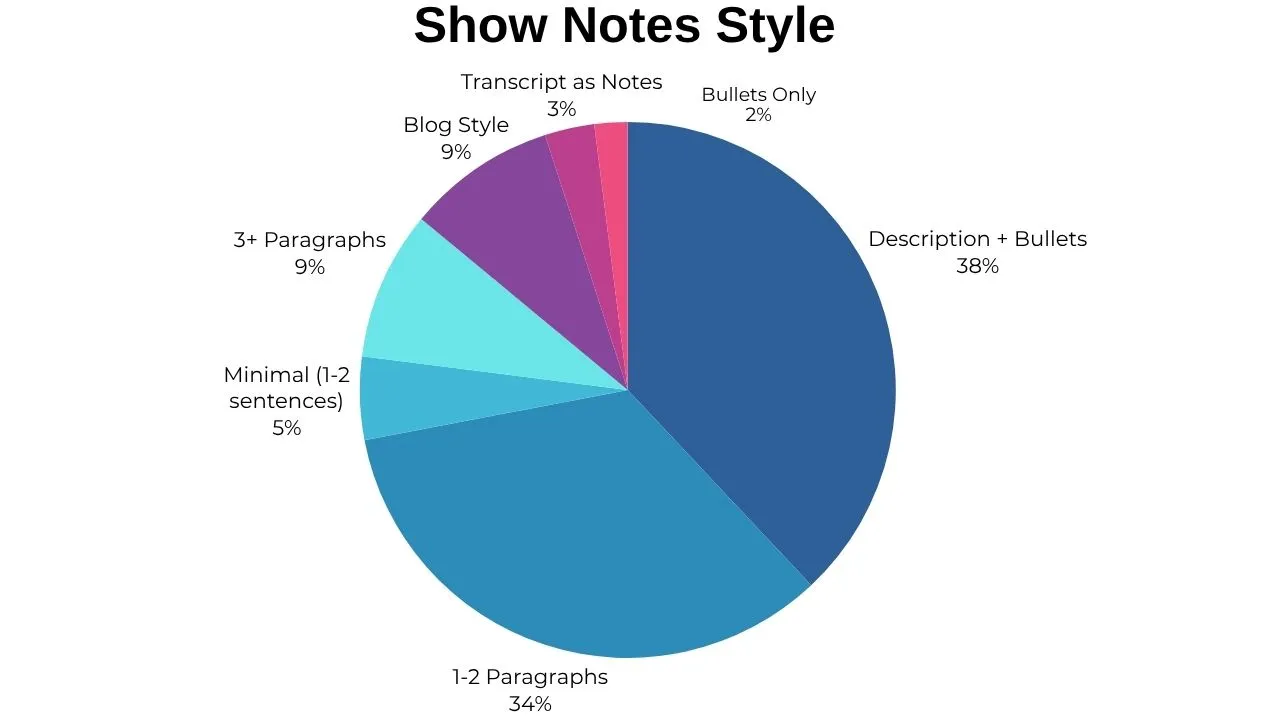
We look at how much and what kind of content is created and released with each episode. We always look frist at websites for these notes, and if notes aren’t on individual pages we consult Spotify and/or YouTube.
Shownotes are one of the elements that seem to change a lot from year to year – maybe it’s new technologies available, maybe it’s different goals for podcasting, maybe it’s different amount sof resources being devoted to the project.
Overall, notes are longer this year, with minimal or 1-2 sentence notes making up only 5% of the total, compared to 23% last year. The classic bullet + highlights notes has gained some ground from 26% to 38%. There are also a few more shows using blog style notes (4% to 9%) and using a ful transcript as notes (1% to 3%).
Assets Included with Show Notes
or the resources included with show notes – what podcast hosts chose to include with notes was also quite different than last year – more similar to a few years ago. Guest information, social media link and guest links and bio-information are all increased, while opt-ins hve decreased which may indicate that audience engagement and relationship building are higher priorities this year. Please note we count Transcripts separately. Below are the instances we counted of each element.
Social Links: 53
Guest Bio Info: 41
Guest Links: 33
Timestamps: 31
Resources Mentioned: 28
Sponsor Links: 24
Products to buy: 24
Podcatcher Links: 23
Opt Ins: 15
Related Episodes: 11
Privacy / Disclaimer: 11
Quotes: 11
Credits: 8
Other Network Shows: 4
Nothing: 4
Subscribe to Premium: 4
Guest Application: 3
Sponsor Application: 2
Sharing Copy: 1
Transcripts
Transcripts are something that can often be nice to provide. They make the show accessible to people who are hearing impaired, and they are searchable texts that internet robots can read, but including them isn’t a popular choice among the top 100, with only 23% sharing them. 8% provided an edited transcript where the content has been polished and formatted to be easily read, and 14% have a straight transcript with few or no changes. 1% decided to keep transcripts for premium subscribers only.
Podcatchers
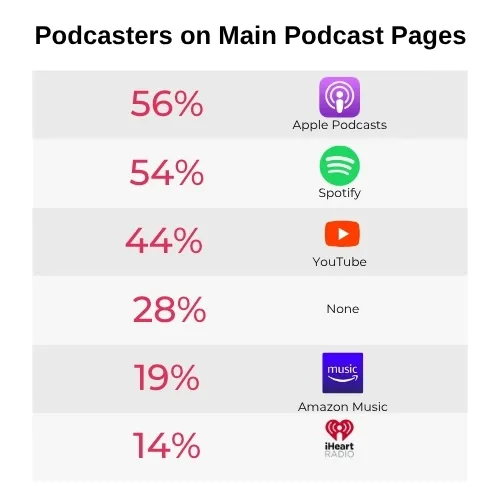
Last year we say a major shift in terms of which podcatchers – or other places to view, listen to and subscribe to content – were shared on podcast websites, with the big players – Apple, Spotify and YouTube taking a major lead over smaller players.
These trends have continued. Looking at the past few years, it’s a real consolidation of which platforms are being prioritized, but whether that is based on audience behavior, or host decisions, or even advice from in house and agency producers is unclear.
Podcast Schema
Earlier this year it seemed like everyone was talking about podcast episode schema as a way to induce the LLMs to present your show… but that is likely more reflective of where we here at OSC spend our time online than anything else. 😉
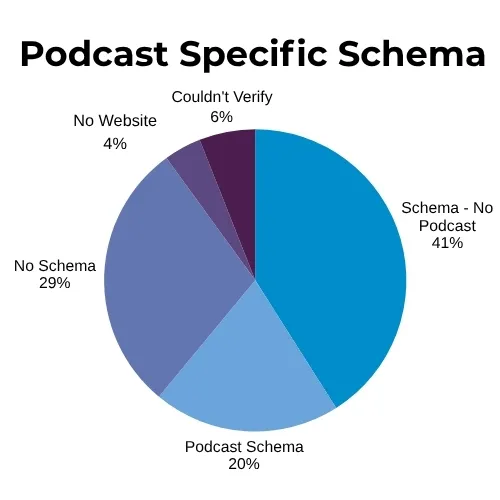
Either way, we decided to take a peek at whether the businesses running the top 100 podcasts this year were using it. The results were interesting.
61% of the shows we looked at are using schema, but only 20% are using podcast-specific schema (the categories provided by Schema.org)
Now, how do the different search engines and LLMs actually USE podcast schema when crawling the internet and surfacing results for users?
Many sites that use schema do so through their SEO plugins, most of which don’t make items like Podcast Series and Podcast Episodes available, at least at most levels, so deploying it can be more difficult than more standard types like FAQ or Local Business. Our official line is that it certainly won’t hurt and it might help, so if you’re creating schema anyway, you might as well identify your podcast and episodes where possible.
Numbers and Guest Names in Titles
On to episode titles.
Last year, the popularity of including an episode number in the podcast title decreased from 45% to 30%, and this year it’s similar, with 33% of shows choosing to do it.
On the Guest Name front, there is a slight decrease this year from 59% to 56%. Of note here is that there were more solo shows this year where there is no guest to name, and so the proportion of podcasts with guests that have the guest name in the title is higher. Best practice was, and still is, to include a guest name in the podcast title if you have one.
Title Styles
Title style is always interesting to look at!
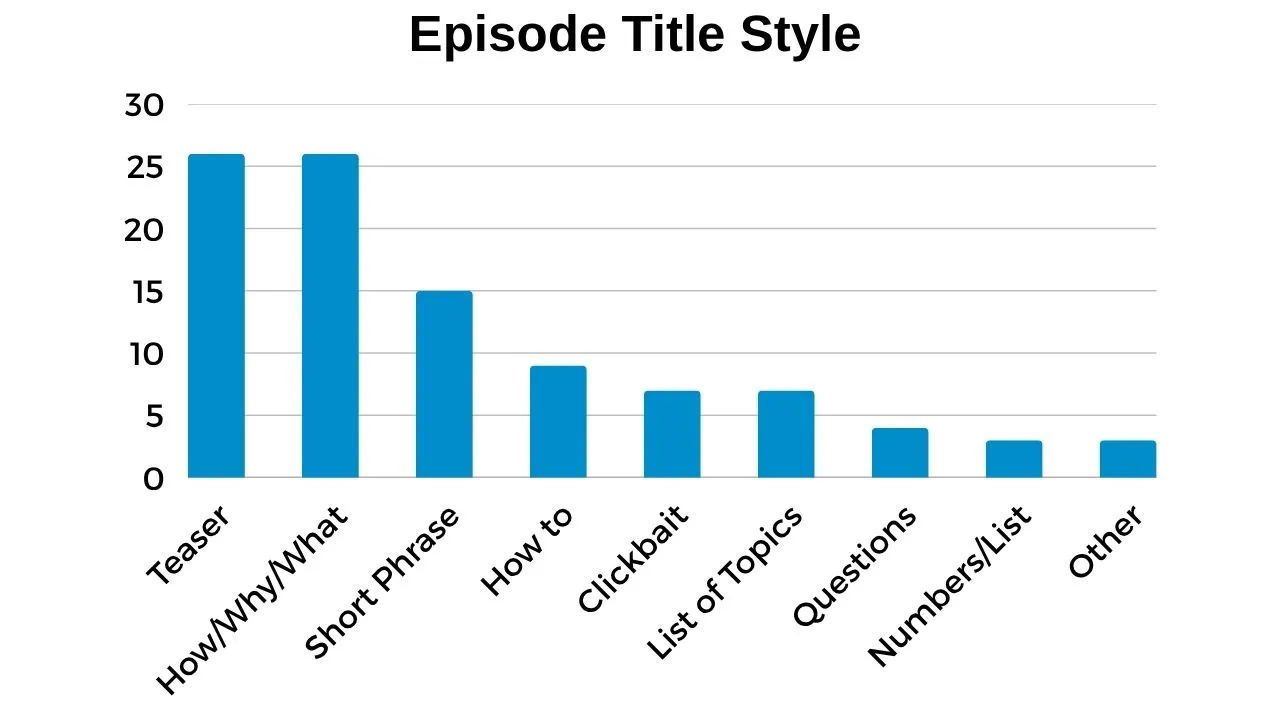
This year, we looked at both title type, the main descriptive part of the title, and whether or not they were using a formula. Many shows alternate from time to time, so we selected the type they used most frequently.
A formula is a combination of elements, or specific arrangement of the title content.
Guest Name: Why X does Y in Math – Stories from Experts | Ep. 204 is a formula title and a Why / What / How title.
Unbelievable secrets revealed about your business! is a Clickbait title, and not a formula.